NotesCanvas Is Not a Sticky-Note App. It’s a Thinking Model Canvas.
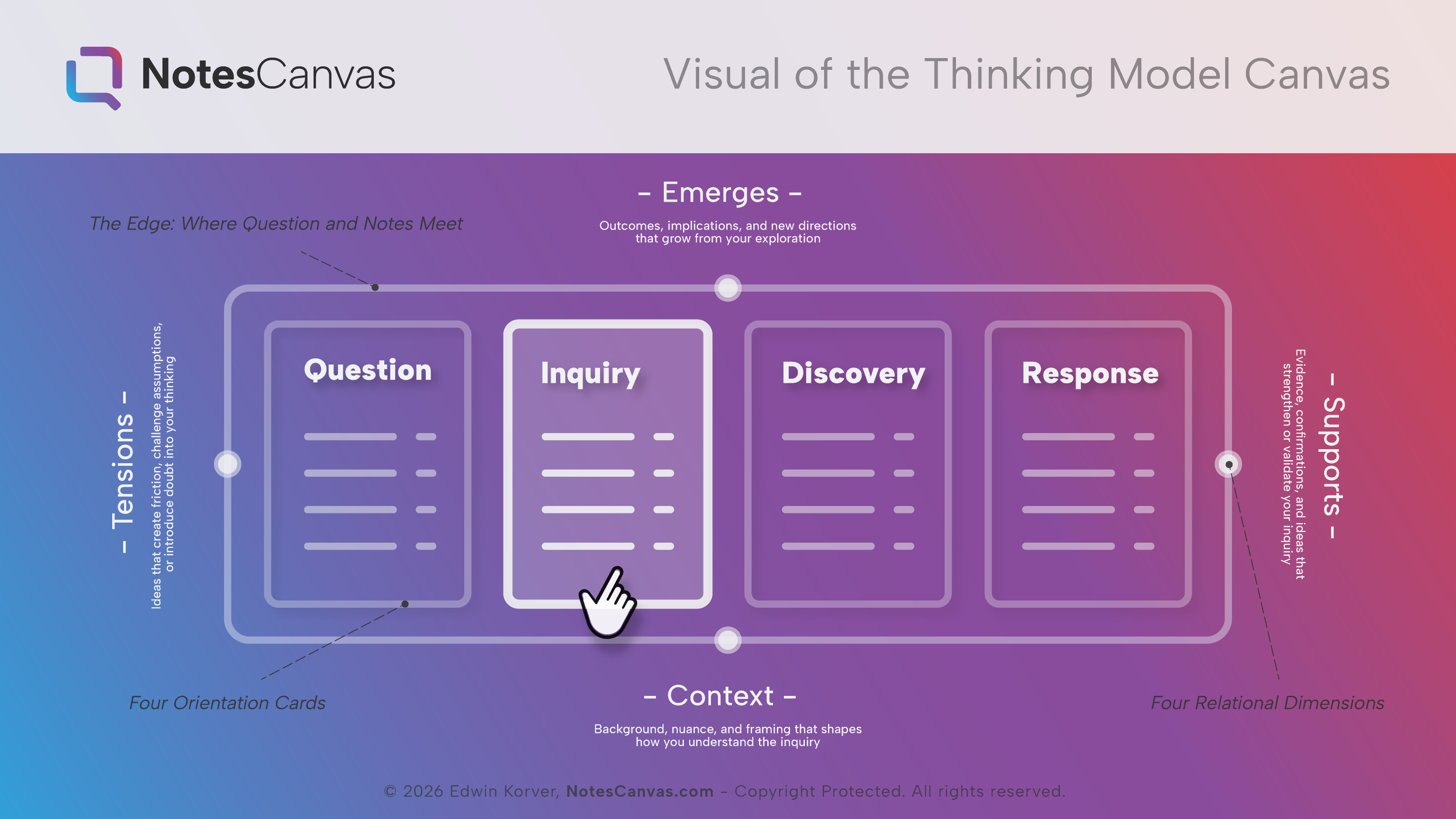
NotesCanvas is built around the idea that thinking has structure — and that structure can be made visible. Unlike typical note-taking tools that treat thinking as a storage problem, it offers a Thinking Model Canvas: a framework that guides you through four stages (Question, Inquiry, Discovery, Response) while organizing your notes across four relational dimensions (Tensions, Context, Supports, Emerges). AI assistance is available but deliberately subordinate to your own judgment. The result is a tool designed for anyone who regularly wrestles with genuinely hard questions — turning messy, unresolved thinking into something consequential.
And yes, that distinction matters more than you think.
When most people hear “notes canvas,” they picture a digital corkboard — a place to pin thoughts, drag things around, and feel productive without actually producing anything. That’s a fair assumption. It’s also completely wrong.
NotesCanvas is built around a different idea entirely: that thinking itself has structure, and that structure can be made visible.
We call it the Thinking Model Canvas — a methodical framework for navigating complexity, in the same spirit that a Business Model Canvas gives entrepreneurs a coherent way to think about a business. Not a template to fill in. Not a form to submit. A lens through which messy, multi-dimensional problems begin to reveal their shape.
The Problem with “Just Writing It Down”
Most knowledge tools treat thinking as a storage problem. Capture the note. Tag it. Find it later. Done.
But anyone who has grappled with a genuinely hard question — a strategic dilemma, a design challenge, a research problem without an obvious frame — knows that the real obstacle isn’t storage. It’s orientation.
You don’t know what you’re looking for until you know what you’re asking. You can’t see the pattern until you’ve mapped the terrain. You can’t form a response until you’ve honestly interrogated the tensions pulling against each other.
NotesCanvas was built for that process — the messy middle between “I don’t understand this yet” and “now I know what to do.”
The Four Orientations of Thinking
The Thinking Model Canvas is organized around four orientation stages:
Question → Inquiry → Discovery → Response
These aren’t steps in a checklist. Thinking doesn’t move in a straight line, and the canvas doesn’t pretend otherwise. You might begin in the middle of an inquiry that forces you back to reframe the question. A discovery might obsolete your initial response. The process is inherently recursive.
But every orientation is essential:
- Question — The driving question, the open problem, the thing worth understanding. Not a task to complete, but a genuine uncertainty to inhabit. A good question is the engine of the entire canvas.
- Inquiry — The active pursuit of understanding. What do you need to explore? What assumptions are baked into your framing? What disciplines, perspectives, or bodies of knowledge belong here? Inquiry is where intellectual honesty lives.
- Discovery — What emerges when you actually look. Surprising connections. Counterintuitive findings. Evidence that complicates the picture. The canvas holds these without forcing premature resolution.
- Response — Not a conclusion for its own sake, but a considered position: a decision, a framework, a reframing, an action — or sometimes the clarity that more inquiry is needed. Response is where thinking becomes consequential.
At each stage, the canvas offers guiding questions to orient you. Not mandatory prompts. Not a script. Just useful provocations when you need them.
Four Dimensions of Association
Here is where NotesCanvas departs most radically from anything else in the notes landscape.
Every note you bring to a canvas — a scribble, a clipping, a research paper, a voice memo transcription — can be associated with the driving question along four relational dimensions:
- Tensions — What pulls against the question? What forces, constraints, or contradictions create friction? Understanding tensions isn’t about resolving them prematurely; it’s about seeing the actual shape of the problem.
- Context — What surrounds and conditions the question? History, environment, stakeholders, systemic forces. Context is what prevents solutions from being technically correct but practically absurd.
- Supports — What evidence, frameworks, examples, or resources lend weight to a direction? What builds the case, or opens a path?
- Emerges — What does the thinking generate? New questions, unexpected implications, tentative hypotheses, speculative connections. The most interesting things often live here.
These dimensions aren’t mutually exclusive categories. A single note might carry tension and context. The canvas lets you hold that ambiguity without collapsing it into something falsely tidy.
Strength of Association
Not all connections are equal, and the canvas knows it.
Associations between notes and the driving question can be strong, weak, or anywhere in between — and this can be visualized on the canvas itself. You can toggle the visibility of associations, filtering your view to see only what matters for the current stage of thinking.
This is more than an aesthetic feature. It reflects something true about cognition: in complex problems, the signal-to-noise ratio is itself a judgment call. The canvas lets you make that judgment explicit and revisable.
AI as a Thinking Partner, Not a Thinking Replacement
At any point in the process — any orientation, any dimension — you can invite AI assistance into the canvas.
But the interaction is deliberately calibrated. AI suggestions can be accepted, edited, or ignored. There is no automatic integration, no silent rewriting of your work. The human remains the author of the thinking process. AI plays the role of an informed interlocutor: capable, available, and appropriately subordinate to your judgment.
This matters philosophically. NotesCanvas is built on the conviction that cognitive sovereignty — the capacity to think for yourself, with your own frameworks, toward your own understanding — is not something to be outsourced. AI can accelerate and challenge and surface what you might have missed. It cannot do the thinking for you. Nor should it.
From Clarity to Consequence
When the thinking matures — when the question has been genuinely interrogated and a response has taken shape — the canvas doesn’t just sit there. It enables forward motion.
You can:
- Crystallize the outcome into a note to carry into the next problem
- Spawn a new canvas, chaining it to this one so the lineage of your thinking stays intact
- Share findings with collaborators, making your reasoning transparent and inspectable
- Archive it — not as dead storage, but as a node in a growing network of prior understanding
That last point is worth dwelling on. Every completed canvas becomes a resource — a documented thinking process that can be returned to, built upon, or contradicted. Over time, your canvas archive becomes something more than notes. It becomes an externalized model of how you think.
Who This Is For
NotesCanvas is not for capturing tasks or managing projects. Other tools do that better, and you probably already have them.
It is for anyone who regularly faces questions without obvious answers — researchers, strategists, designers, founders, consultants, writers, anyone whose work requires genuine thinking rather than information retrieval. It is for the person who has ever stared at a collection of notes and felt the shape of an insight just out of reach.
The Thinking Model Canvas gives that shape a home.
NotesCanvas — From notes… to knowing.