
The Fourth Room: From Thinking Hard to Thinking Well
Most tools help you capture what you know. Fewer help you make sense of it. None help you find your way back to how you got there. This post is for the people who have spent years thinking hard about something that matters — and know exactly what it costs when the structure isn’t there.
Four Rooms. Four Ways of Not Quite Thinking.
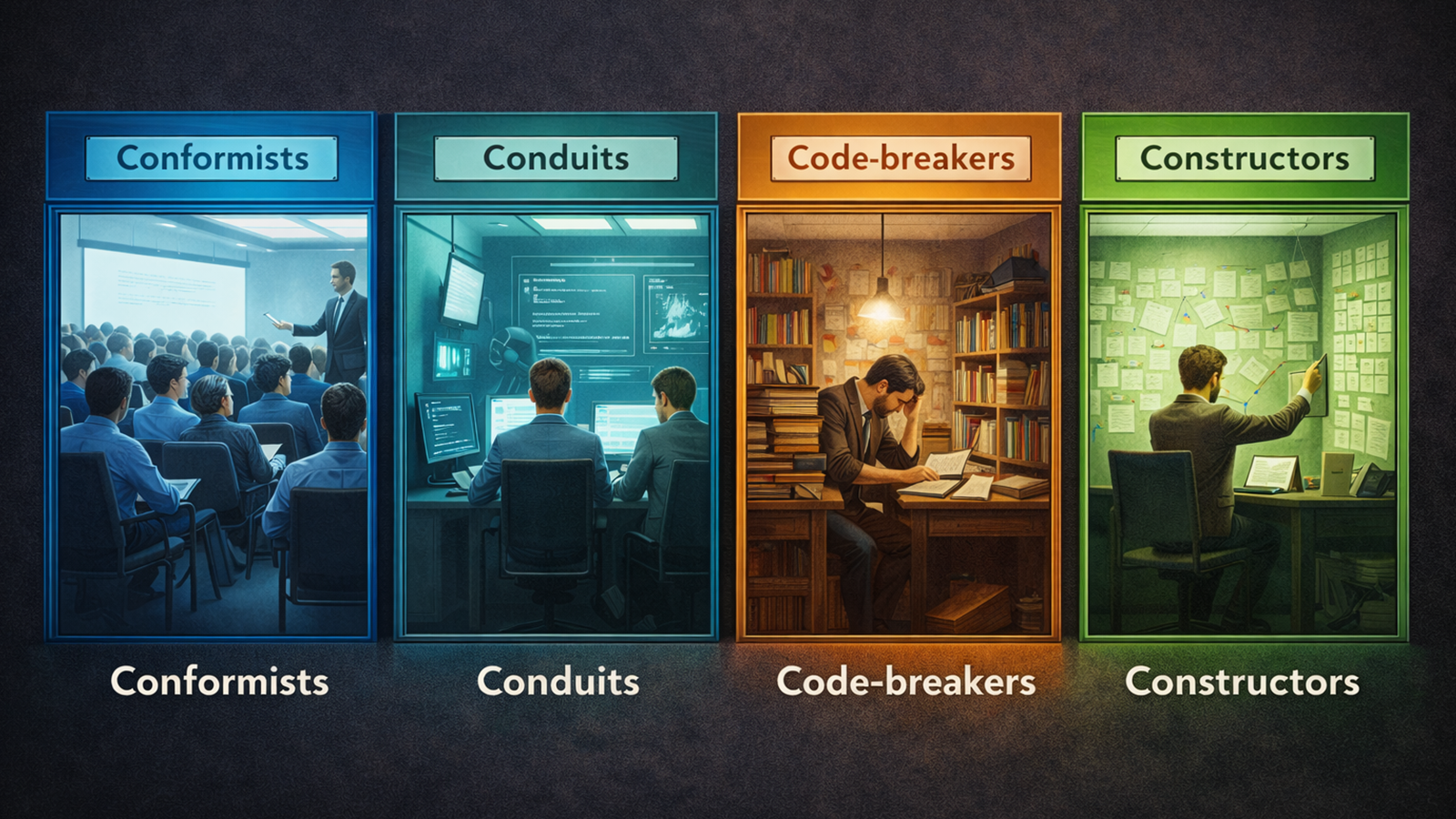
Most people never choose how they think. The choice was made for them, quietly, over years of schooling and work that rewarded compliance over curiosity. Call them Conformists. They live in the first room: don’t bother. Things are as they are. It isn’t laziness — it’s adaptation. The industrial world was not built for people who questioned it.
Then there is the second room: full delegation. Let the tools think. Let AI synthesize, summarize, conclude. Call them Conduits — information passes through them without being genuinely transformed. It’s fast, it’s frictionless, and it feels like thinking. And it offers something room one never could: a sense of power. Where Conformists follow the crowd, Conduits direct the machine. There is a real comfort in that — in feeling that you are, at least, in control of something.
But direction isn’t thinking. The hard part — the questioning, the weighing, the honest reckoning with what you don’t yet understand — has simply been handed off. AI can be a genuine companion to thought. But the comfort of delegation comes at a price: you retain the feeling of having thought, without having done it. In that sense, the Conduit isn’t so different from the Conformist. Both are externally driven; the source of authority has simply shifted from the social to the algorithmic. The danger isn’t just that you stop thinking. It’s that you stop knowing you have.
The third room is where most serious people quietly live. Call them Code-breakers. They think. They gather. They read and annotate and connect and return. They care deeply about the problem and put real hours into it. This is not the room of the disengaged — this is the room of people who still consider thinking non-negotiable.
And yet there is an illusion here too — subtler than the Conduit’s, and harder to name because the effort is genuine.
All that gathered material — the books read, the notes taken, the references accumulated, the thinkers you can cite fluently — is latent information. It is not insight. It is not wisdom. It is potential, held in storage, waiting for something to happen to it. The well-stocked library feels like intellectual richness. In a sense it is. But it is not thinking. Thinking only begins when that material is challenged, tested, opposed, supported, brought into contact with a question that has genuine stakes. Until then, it is closer to showing off — to yourself as much as to others.
The Conduit has access to a vast and articulate intelligence and mistakes that access for understanding. The Code-breaker has accumulated a vast store of knowledge and makes the same mistake. Both are sitting in front of something powerful, convinced the proximity is enough.
It isn’t.
The fourth room belongs to the Constructors — those who don’t just gather or direct, but build: frameworks, arguments, structures of understanding that can be examined, shared, and extended. Most Code-breakers don’t know this room exists. Those who find it don’t go back.
What the Third Room Actually Costs
If you are a Code-breaker, you know the feeling — even if you’ve never quite named it.
You’ve been circling something for months. Maybe years. You have a sense of it. You’ve read widely, thought carefully, filled notebooks or documents or apps with fragments that feel important. But you can’t get it to cohere. The insight feels close and stays fuzzy. You reach a conclusion, but you can’t fully trust it — because you can’t see how you got there.
There is a particular cruelty to the moments when it almost works. When everything suddenly lines up and you can see the shape of the whole thing clearly. And then, hours later — or the next morning — it’s gone. Not the conclusion, maybe, but the path. The chain of reasoning that made it feel true. You’re left with a feeling where an argument should be.
So you go over it again. And again. At your desk, on a walk, at three in the morning when your mind refuses to let it rest. You return to the same territory so many times you start to wonder whether there’s anything there at all, or whether you’re simply not capable of cracking it.
The loneliness of this is real. The problem is too complex, or too half-formed, to explain to anyone else. You can’t ask for help because you can’t articulate what you’re stuck on. The people around you are living in different rooms — they don’t have the vocabulary for what you’re trying to do, let alone the patience for it.
And quietly, without admitting it, you start to cut corners. You avoid the ideas that contradict your thinking, because incorporating them would mean rebuilding what you’ve already built — and you’re not sure you have the capacity for that. You stop reading certain thinkers because engaging honestly with them would cost too much. You lose confidence in your ability to hold it all in mind. So you hold less. And the picture shrinks.
Here is where the Code-breaker is most at risk. Under sustained cognitive pressure — the weight of complexity, the exhaustion of years — the temptation to reach for AI shortcuts becomes real. The path of least resistance runs straight back to room two. Not out of laziness, but out of necessity. Without a structure that externalises the load, even the most capable thinker is always one hard month away from becoming a Conduit.
This is not weakness. This is what thinking without structure costs — in sleep, in confidence, in honesty, in the understanding that keeps almost arriving and never quite does.
What I Was Missing
I know this room from the inside. For nearly a decade, I was trying to understand something that mattered enormously to me: why the business world was wasting human potential on such a vast scale. Why people were being left to struggle. Why communities were hollowing out, environments degrading, wealth concentrating, and alienation spreading — while the systems responsible kept describing themselves as rational and efficient.
I had my notes. My diagrams. My blog posts. My passion. Occasionally, someone I could talk to about a particular finding, which helped me gain a little clarity before I was alone with it again.
What I didn’t have was structure. What I was missing were breadcrumbs — a way of knowing how I had arrived at an understanding, so I could retrace the path, verify it, share it, build on it. Instead, every insight was provisional. Unverifiable. Potentially resting on a step I’d already abandoned without realising it.
I also wasn’t always honest. I avoided ideas at odds with my thinking. I stopped incorporating what others had concluded, because I was losing confidence in my ability to keep it all in mind. The problem wasn’t intelligence or effort or commitment. The problem was that I had no instrument adequate to the work I was trying to do.
I built NotesCanvas because nothing else existed. And because I couldn’t afford to keep thinking without it.
The Distinction That Changes Everything
Moving from Code-breaker to Constructor is not about working harder. You are already working hard. It is about understanding what kind of tool thinking actually requires.
There is a crucial distinction that most conversations about AI and cognition miss entirely. The Code-breaker’s problem is not that they are thinking too much — it is that they are using their mind as a storage device as well as a thinking device, and the two functions are in constant competition. Working memory is finite. When it is consumed by holding the structure of a problem together, less of it is available for the actual work of inquiry.
What the Code-breaker needs is not a thought prosthetic — something that thinks in their place. That is the Conduit’s solution, and it costs the one thing the Code-breaker has refused to surrender: the thinking itself. What they need is a memory prosthetic — something that holds the structure externally, so the mind is freed to do what only minds can: see patterns, make connections, ask better questions, sit with genuine uncertainty.
This is the distinction NotesCanvas is built on. It does not think for you. It remembers with you — keeping the shape of the inquiry intact so you don’t have to, leaving your cognitive capacity available for the harder and more interesting work.
In the third room, thinking is an act of memory. In the fourth room, thinking is an act of construction. The connections live outside your head, in a structure you can return to, interrogate, and extend. You can see where you came from. You can see what is supported and what is assumed. You can follow the thread back to the original question and ask honestly whether you’ve answered it — or only convinced yourself you have.
This is what the scientific method gave researchers: not a guarantee of truth, but a structure that makes research auditable. They can show their work. They can find where they went wrong. They can hand their reasoning to someone else and have them walk through it. NotesCanvas offers the same thing for individual thought — four orientations (Question, Inquiry, Discovery, Response) that give the shape of thinking a visible form, and an epistemological trace that keeps the path intact long after the moment of clarity has passed.
You choose the question. The method holds the thread.
The Invitation
This post is not for everyone. Most Conformists are not looking for it, and that is not a moral failure — it is the predictable result of a world that trained people out of the thinking habit long before they had a chance to develop it.
It is also not primarily for Conduits, though they are welcome. The costs of full delegation will become clear soon enough.
This is for the Code-breakers. The ones who are already doing the hard part. The ones who know what it is to care deeply about a question and spend years circling it. The ones who have felt the slippage, the sleeplessness, the loneliness of the unfinished thought — and who have, on their worst days, wondered whether reaching for an easier tool might finally be the rational thing to do.
It isn’t. Not if the thinking matters. Not if the question is real.
You don’t need more effort. You need a better structure. One that carries the load so your mind doesn’t have to — and leaves you free to do the one thing no tool can do for you.
The fourth room is there. NotesCanvas is the door.
NotesCanvas is a Thinking Model Canvas — a structured environment for deep inquiry, designed for people who take their own thinking seriously. Start thinking clearly →
Photo by Milad Fakurian on Unsplash